
Notice: The project is still being changed around, but most of this should still stay the same.
This page is here to document my own personal homebrew computer project, the Alvord Homebrew PC.
What is the Alvord?
The Alvord Homebrew Computer (named after the Alvord Desert in Oregon) is the culmination of about a year of research and development as of writing this, and it is also my dream project.
It is a semi-complex homebrew computer based around the 65C816 microprocessor shown below. It will come stock with SCSI-1 support, a built in RTC, and a couple other ammenities.
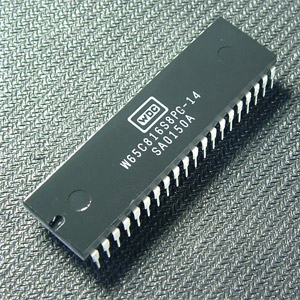 WDC 65C816 Microprocessor, DIP-40 form.
So far, a prototype has not been built, but I am working hard to build one as soon as possible.
For what purpose did I make this?
The Alvord was made for 2 reasons; continuing a dead project of mine and trying to outperform the british.
This may sound like insane people talk, but let me explain.
Back in 2024, I started learning how simple homebrew computers worked, eventually by 2025, I had a Z80 that I was messing around with. However, like all things, I lost interest, and left my project on a shelf, collecting dust. This was really until some british person I know showed me some Z80 handheld computer thing, which finally inspired me to get back to work with a new goal:
Make a computer which outperforms theirs, and make it marketable, too.
I shifted my focus to the 65C816 as its still in production, and decided I will try and only use parts still in production for this and to make sure its more powerful than the british persons computer.
You may still be asking "But why, nathan? Why do this?" My response?
I find it funny.
Yes, the concept of some strange device built in my garage outperforming a real consumer product is roughly half the reason I still work on this, cause I find that funny.
So now the Alvord is in development, with the simple goal of "Go fast, be decent."
Possible Specs
Here are some possible specs the machine may have on release. This list is not final, and may change in the future depending on where this project goes.
- CPU: 3.072MHz 65C816 by WDC
- RAM: Roughly 32KB "Low Memory", upto 4MB of "High Memory" on expansion sticks (1MB each, 4 memory slots)
- ROM: Alvord ROM, 32KB
- Storage: Anything attached via SCSI using the CN-50 port
- I/O: SCSI-1 External Port, 2x RS232 ports (mainly for communicating with the machine due to lack of graphics)
- OS: NT-SOS Release "Hood" (or NT-SOS Testing Build "Kelly Butte")
I've decided to heavily rely on SCSI for this system, as I've implemented a blazing fast burst DMA system (512 bytes, optimized for SCSI, so using it for expansions should be fairly simple for the developer to implement.
Can I get one when it comes out?
Short answer: Maybe?
I have no clue how much these will cost to build, but hopefully it shouldnt be too much. If I do sell this, I want to undercut the competition by a decent amount price wise, as personally I find these homebrew computers assembled or otherwise to be a tad bit overpriced.
Be aware however that if I do sell this, I'll make sure to support it for as long as possible. That means completely free OS updates for as long as possible.
The OS (NT-SOS)
NT-SOS (Nathan Technologies Single Operating System) is the OS that will ship with the Alvord, I want it to behave mostly similar to early MS-DOS and DEC RT-11 and not do much else. It's designed to be very deterministic, only running one program at once. I plan on also releasing it under an Apache V2.0 license, so anyone can use it however they want.
NT-SOS's different releases have different codenames. Here are a few planned ones.
| Version | Codename |
|---|---|
| Alpha | Mazama |
| Beta | St. Helens |
| Release | Hood |
| *Testing | Kelly Butte |
(* Testing release will always be named "Kelly Butte", and never be discontinuted. It is akin to a rolling release type of system like Arch Linux or Debian Sid)
I intend on not selling Alvords with Alpha or Beta software, but I will release the software later on for archival reasons.
Updating NT-SOS will be done through downloading a update over a serial port to the attached SCSI device or via copying a later version of NT-SOS directly to the main drive.
I plan on adding a myriad of improvments over time, mainly just stability stuff and bugfixes.
NT-SOS and the alvord as a whole will be "supercharged" by the Alvord ROM. Despite being very simple, the ROM has SCSI, Serial, and more routines baked in. Basically, I want developers to use a mixture of ROM routines and OS routines for maximum efficiency.
Future Plans
Various ideas are planned for the future of this project, some of which are listed below. Some of these might be developed further, and some may never come to fruition, so no promises that any of the following will ever be released.
- More I/O options
- Miniature model with surface mount components to save space.
- And More!
(C) Nathaniel Dean Carman 2025-2026, All Rights Reserved unless stated otherwise.
Need my GPG Key? Get it Here!
Contact Me!


